LumaConfig CLI in Home Assistant
LumaConfig CLI can be used inside Home Assistant to perform batch actions on multiple Luma devices, such as exporting statistics, exporting configurations, and deploying firmware.
Requirements
- Home Assistant with access to the
/configfolder - Python 3
- Network access to the Luma devices
- The Luma service key
- Luma devices reachable by hostname or IP address
By default, the tool scans devices using hostnames such as:
lumaconfig-01.local
lumaconfig-02.local
...
lumaconfig-16.local
Installation
Copy the CLI script to the Home Assistant python_scripts folder:
/config/python_scripts/lumactl.py
Make the script executable if required:
chmod +x /config/python_scripts/lumactl.py
Create the required folders:
mkdir -p /config/python_scripts/export_stats
mkdir -p /config/python_scripts/export_config
mkdir -p /config/python_scripts/software
Firmware ZIP files can be placed in:
/config/python_scripts/software
Basic usage
Open the Home Assistant terminal or SSH add-on and run:
cd /config/python_scripts
python3 lumactl.py
If no mode is provided, the tool asks for the operation mode and service key interactively.
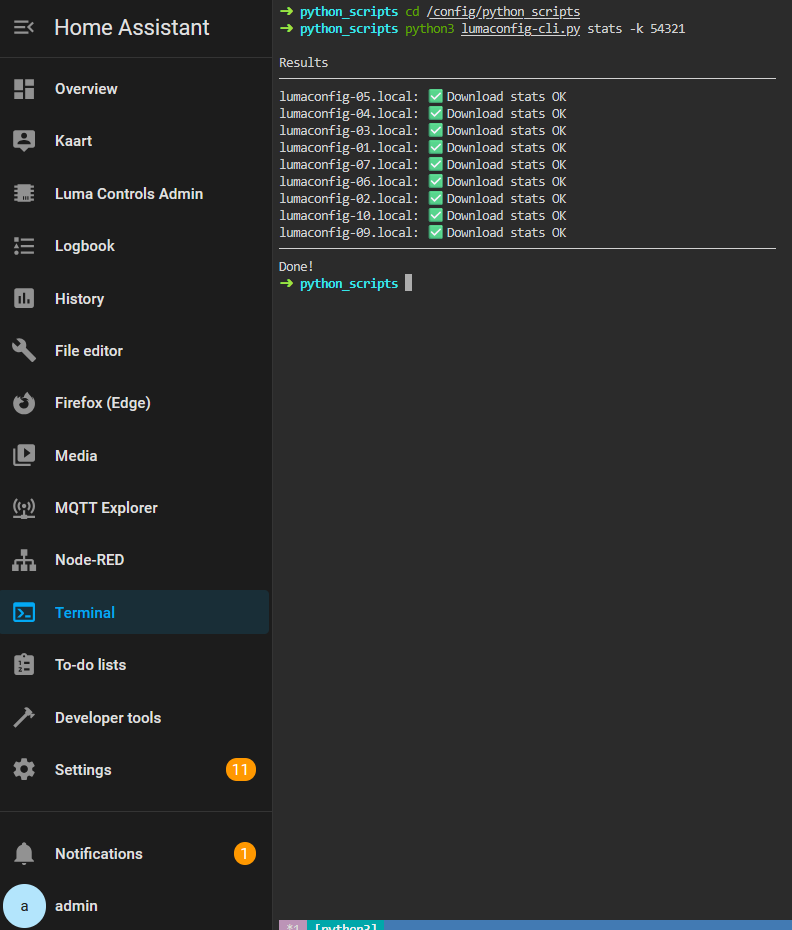
Export device statistics
python3 lumactl.py stats --service-key YOUR_SERVICE_KEY
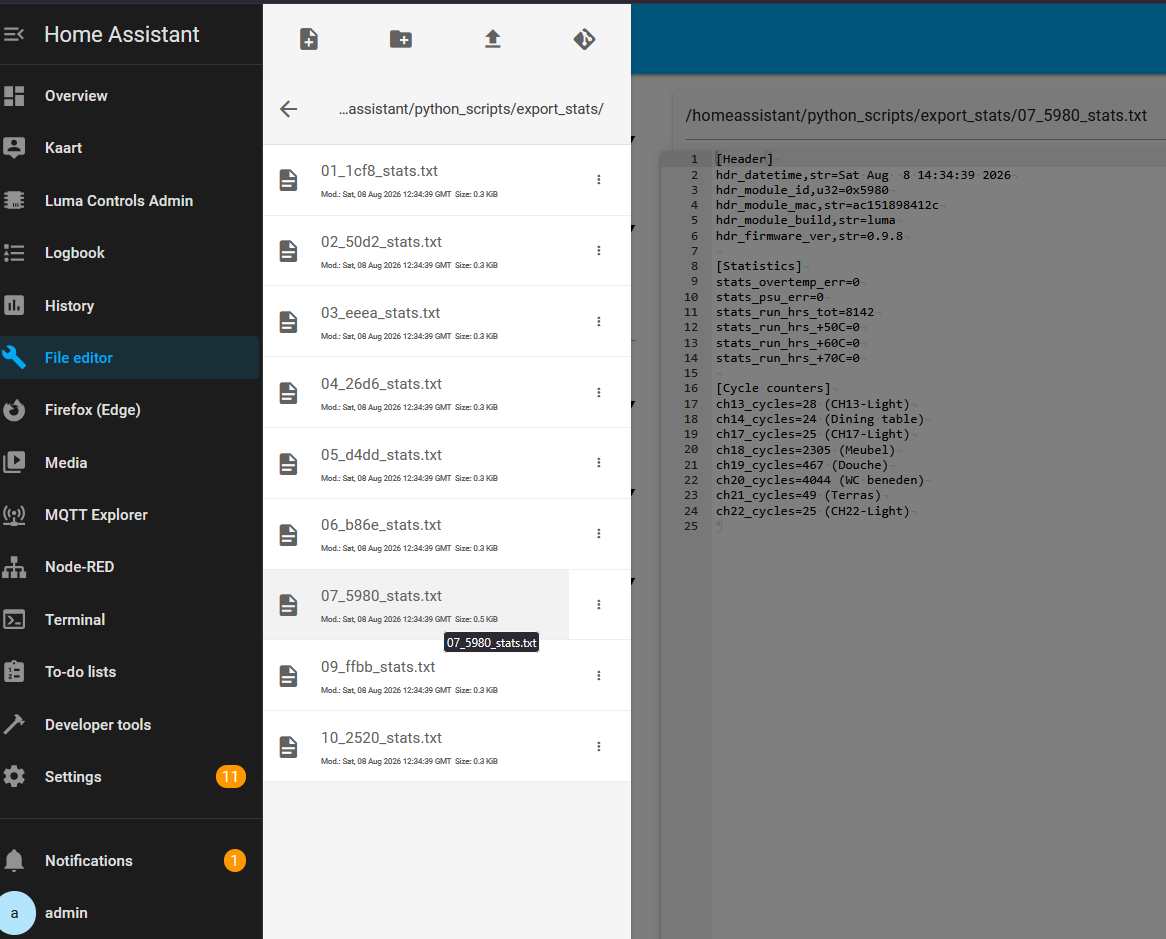
Statistics files are saved to:
/config/python_scripts/export_stats
Export device configuration
python3 lumactl.py config --service-key YOUR_SERVICE_KEY
Configuration files are saved to:
/config/python_scripts/export_config
Deploy firmware
Place the firmware ZIP file in:
/config/python_scripts/software
Then run:
python3 lumactl.py fw --build luma --service-key YOUR_SERVICE_KEY
For the Automate build:
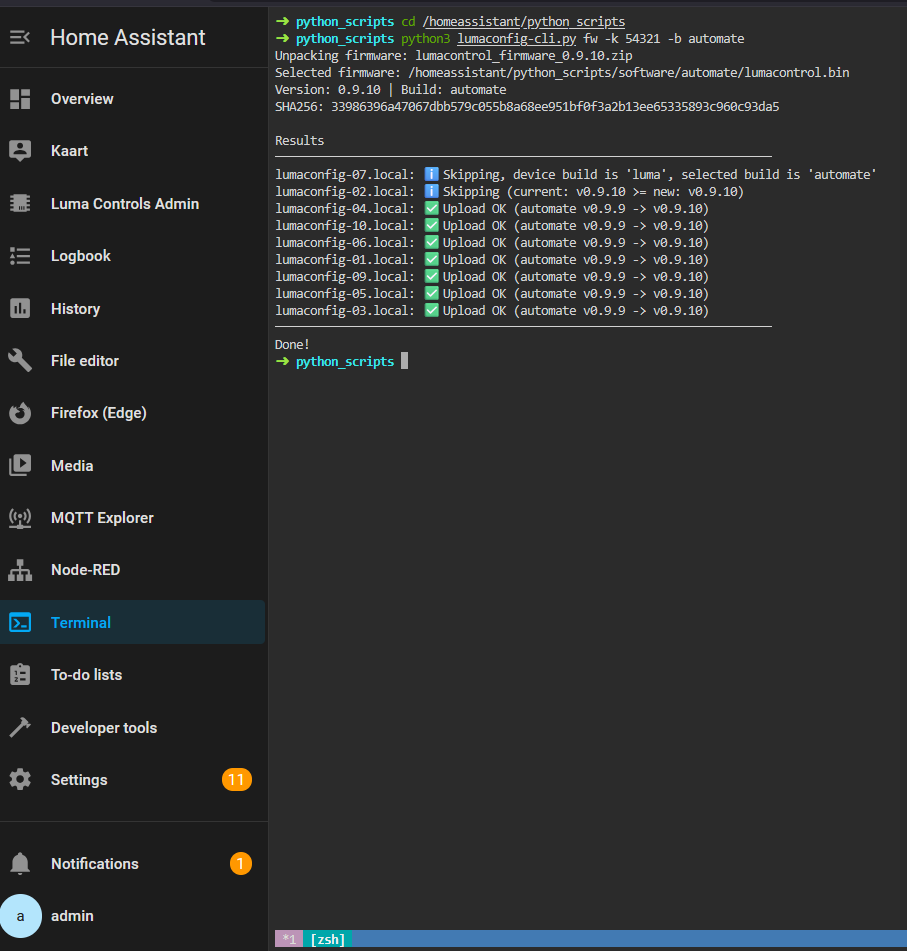
python3 lumactl.py fw --build automate --service-key YOUR_SERVICE_KEY
The tool automatically selects the newest firmware ZIP file, checks the manifest, verifies the firmware hash, and uploads the correct firmware build to compatible devices.
Select specific devices
Use explicit hostnames or IP addresses:
python3 lumactl.py stats --service-key YOUR_SERVICE_KEY --devices 192.168.1.50 192.168.1.51
Or generate a hostname range:
python3 lumactl.py stats --service-key YOUR_SERVICE_KEY --range 1 8
This scans:
lumaconfig-01.local
...
lumaconfig-08.local
Parallel workers
By default, the tool uses 8 parallel workers. This can be changed with:
python3 lumactl.py stats --service-key YOUR_SERVICE_KEY --threads 4
Use fewer threads on slower networks or when updating many devices at once.
Debug output
To show connection errors and additional HTTP details:
python3 lumactl.py stats --service-key YOUR_SERVICE_KEY --debug
Firmware version checks
By default, firmware is only uploaded when the selected firmware is newer than the version already installed on the device.
To force upload even when the version is the same or older:
python3 lumactl.py fw --build luma --service-key YOUR_SERVICE_KEY --skip-version-check
Use this option carefully.
Recommended Home Assistant folder layout
/config/python_scripts/
├── lumactl.py
├── export_stats/
├── export_config/
└── software/
└── lumacontrol_1.2.3.zip
Example workflow
cd /config/python_scripts
# Export statistics from all devices
python3 lumactl.py stats --service-key YOUR_SERVICE_KEY
# Export configurations
python3 lumactl.py config --service-key YOUR_SERVICE_KEY
# Deploy latest Luma firmware
python3 lumactl.py fw --build luma --service-key YOUR_SERVICE_KEY